
M&E Methodology Selection: The Complete Practical Framework
February 13, 2026 2026-02-13 19:05M&E Methodology Selection: The Complete Practical Framework
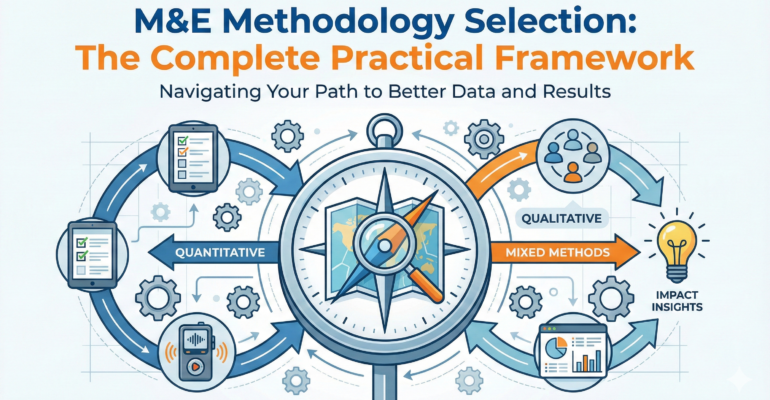

Quick Answer: How to Select the Right M&E Methodology
The right M&E methodology balances seven factors:
- Complexity level vs. expertise available
- Evaluation purpose (needs assessment vs. impact),
- Program stage,
- Qualitative/quantitative/mixed methods needs,
- Sector-specific standards,
- Stakeholder participation level, and
- Budget/time constraints. Simple methods beat complex ones when context doesn’t support sophisticated designs.
Critical Insight: A poorly matched methodology wastes 60% of your M&E budget and generates findings stakeholders ignore. A well-matched approach delivers credible results within practical constraints.
Why Methodology Selection Determines Evaluation Success
The consultant’s proposal looked impressive: Randomized Controlled Trial (RCT) design, structural equation modeling, propensity score matching. The donor was convinced. The budget director saw a problem—60% of the annual M&E budget consumed, 18 months required, statistical expertise unavailable in-country.
Six months later, the RCT collapsed. Randomization was impossible because the program had already rolled out everywhere. Network analysis felt intrusive to communities. Sample sizes were unachievable. The evaluation was redesigned from scratch—months wasted, relationships damaged, resources consumed without findings.
The lesson: Methodology selection is not about choosing the “most rigorous” option. It’s about matching method to context, resources, and purpose. This guide provides a practical framework for making that match.
The 7 Critical Factors for M&E Methodology Selection
Factor 1: Simple vs. Complex Methodologies
Methodology exists on a spectrum. Neither end is inherently superior—the question is which level serves your evaluation purpose while remaining feasible.
Simple Methodologies: Accessible and Adaptable
Simple approaches work for practitioners with varied training levels and adapt to diverse contexts:
| Method | Best For | Resource Level |
|---|---|---|
| Key Informant Interviews (KIIs) | Stakeholder perspectives, implementation insights | Low |
| Surveys/Questionnaires | Systematic data from large samples | Low-Medium |
| Case Studies | In-depth process understanding | Low |
| Direct Observation | Behaviors activities missed by interviews | Low |
| Most Significant Change (MSC) | Stories of transformation from beneficiaries | Low |
| Focus Group Discussions (FGDs) | Collective perspectives, social dynamics | Low |
Strengths: No specialized software required. Adapts to field conditions. Shorter training. Lower cost.
Complex Methodologies: Analytical Power
Advanced approaches provide rigorous attribution and sophisticated analysis:
| Method | Best For | Resource Level |
|---|---|---|
| Randomized Controlled Trials (RCTs) | Causal inference, attribution | High |
| Quasi-Experimental Designs | Comparison when randomization impossible | High |
| Outcome Mapping | Complex adaptive programming | Medium-High |
| Social Network Analysis | Relationship patterns, influence flows | High |
| Tracer Studies | Long-term outcomes, sustainability | Medium-High |
| Difference-in-Differences | Policy/program impact over time | High |
Decision Rule: Use the simplest methodology that answers your evaluation questions. Complexity without necessity wastes resources and increases failure risk.
Factor 2: Evaluation Purpose and Objectives
Different evaluation purposes demand different methodological approaches. Mismatching purpose to method produces unsatisfying results.
Diagnostic and Needs Assessment Studies
When understanding gaps, needs, or context:
- Needs assessments: Focus group discussions + key informant interviews
- Resource mapping: Participatory mapping + GIS analysis
- Conflict analysis: Document review + stakeholder interviews + historical timelines
- Stakeholder analysis: Relationship mapping + power analysis
Impact and Change Studies
When measuring program effects:
- Level of change: Baseline-endline surveys with comparison groups
- Consequences analysis: Case studies + outcome harvesting
- Lessons learned: Most Significant Change + retrospective process review
- Trends: Time series with consistent indicators
Key Distinction:
- FGDs and interviews explain how and why changes occurred
- Statistical surveys measure how much and how many
Best Practice: Combine approaches to address both magnitude and mechanism questions stakeholders actually ask.
Factor 3: Stage of Programming
Timing within the program cycle constrains methodology options. Some approaches are impossible or premature at certain stages.
Beginning Phase: Formative Approaches
- Baseline assessments: Establish initial conditions before intervention
- Needs analysis: Identify target populations and priorities
- Stakeholder mapping: Understand actors, interests, relationships
- Risk assessment: Identify potential barriers and enablers
Middle Phase: Process and Adaptation
- Midline evaluations: Assess progress, enable course corrections
- Process evaluations: Document implementation fidelity vs. plan
- Rapid assessments: Quick data for immediate decisions
- Monitoring system review: Verify data quality and utility
Critical Function: Midline evaluations allow adaptive management—upgrading what works, eliminating what doesn’t—while time remains for adjustment.
End Phase: Summative Assessment
- Impact evaluations: Require sufficient time for results to manifest
- Outcome assessments: Compare endline against baseline
- Sustainability studies: Assess persistence after support ends (often 6-24 months post-intervention)
- Cost-effectiveness analysis: Compare results against investment
Timing Constraint: Impact evaluations cannot be conducted prematurely. Attempting impact measurement before outcomes have stabilized produces misleading findings.
Factor 4: Qualitative, Quantitative, or Mixed Methods
Research consistently demonstrates that mixed methods designs, properly implemented, provide more robust findings than either approach alone (Barnow, Pandey, & Luo, 2024).
Quantitative Approaches: Breadth and Generalization
Quantitative techniques answer questions about magnitude:
- Measuring change across populations
- Testing statistical significance
- Generalizing from samples to larger populations
- Quantifying costs, efficiency, cost-effectiveness
Best For: “How much?” “How many?” “To what extent?”
Qualitative Approaches: Depth and Mechanism
Qualitative techniques provide understanding quantitative data cannot:
- Explaining how and why changes occurred
- Revealing contextual factors shaping outcomes
- Capturing unanticipated effects and emergent patterns
- Giving voice to beneficiary experiences
Best For: “Why did this happen?” “How did the process unfold?” “What does this mean to stakeholders?”
Mixed Methods: The Strategic Synthesis
Combining approaches enables:
- Triangulation: Comparing findings across data sources strengthens confidence
- Complementarity: Quantitative shows breadth, qualitative shows depth
- Development: Qualitative informs quantitative instrument design
- Expansion: Quantitative identifies patterns, qualitative explains exceptions
2026 Best Practice: The convergent parallel design—collecting quantitative and qualitative data simultaneously, analyzing separately, then integrating results—is now considered the gold standard for program evaluation (OeNB, 2024).
Factor 5: Sector-Specific Methodologies
Different sectors have established norms and proven methodologies. Understanding these enables leveraging existing tools rather than reinventing approaches.
Sector Methodology Standards:
| Sector | Established Methodologies | Key Tools |
|---|---|---|
| Cash Transfers | Post-Distribution Monitoring (PDM) | Standardized questionnaires, mobile data collection |
| Agriculture | Outcome Harvesting, crop monitoring | Yield assessments, post-harvest quality testing |
| Nutrition | Anthropometric protocols, dietary diversity | MUAC, weight-for-height, 24-hour recall |
| Health | DHS, SPA, facility assessments | Standardized surveys, service statistics |
| Education | EGRA, EGMA, classroom observation | Learning assessments, teaching quality rubrics |
| WASH | Water quality testing, usage monitoring | Rapid tests, flow meters, observation |
| Livelihoods | Market analysis, value chain assessment | Price monitoring, trader surveys |
Critical Balance: Use sector-standard tools for comparability, but adapt to local context. Blind application without contextual consideration produces invalid findings.
Factor 6: Level of Participation and Involvement
Methodologies embody different assumptions about who generates evaluation knowledge and for what purpose.
Participatory Methodologies: Maximum Involvement
Approaches designed to engage stakeholders as active knowledge producers:
- Rapid Rural Appraisal (RRA): Quick participatory assessment with community members
- Most Significant Change (MSC): Stakeholders at multiple levels identify significant changes through iterative dialogue
- Participatory Learning and Action (PLA): Community-led data collection using visual tools and mapping
- Outcome Harvesting: Program staff and partners identify outcomes through structured workshops
Trade-offs: Require more time upfront for relationship-building. Generate deep engagement, build local capacity, increase likelihood findings will be used.
Standardized Methodologies: External Validity
Approaches prioritizing comparability and replicability:
- Randomized Control Trials: Strict protocols with minimal local adaptation
- Standardized surveys: Identical questions across all respondents
- Systematic reviews: Synthesis of existing studies without primary data collection
Trade-offs: Enable statistical analysis and cross-site comparison. Less depth, minimal stakeholder engagement, potential cultural mismatch.
Decision Framework:
- Choose participatory when learning and local ownership are priorities
- Choose standardized when accountability and comparability are priorities
- Hybrid approaches (standardized core with participatory components) often balance both needs
Factor 7: Budget, Time, and Resources
The most rigorous methodology is irrelevant if budget, timeline, or capacity make implementation impossible.
Cost Profiles by Methodology:
| Cost Level | Methodologies | Approximate Budget Range |
|---|---|---|
| High | RCTs, large-scale surveys, longitudinal studies, international consultants | $50,000-$500,000+ |
| Medium | Mixed methods evaluations, multi-site case studies, outcome mapping | $15,000-$75,000 |
| Lower | Photography, observation, small-sample interviews, document review, rapid appraisals | $2,000-$15,000 |
Time Constraints:
- Rapid assessments (2-4 weeks): Key informant interviews, focus groups, document review, observation
- Standard evaluations (6-12 weeks): Mixed methods with surveys, interviews, analysis
- Impact evaluations (6-18 months): Baseline-endline designs with sufficient time for effects to manifest
Expertise Requirements:
- Basic tools: Require little formal M&E training
- Intermediate methods: Require trained data collectors and analysts
- Complex designs: Require specialized statistical or technical expertise
Cost-Efficiency Strategy: Computer-assisted telephone interviews (CATI) cost less than face-to-face surveys for geographically dispersed populations while maintaining large sample sizes.
The Methodology Selection Decision Matrix
These seven factors interact to define appropriate methodology. Effective selection requires considering all simultaneously.
Step-by-Step Selection Process:
- Start with purpose and stage: What questions need answering at this program phase?
- Consider sector norms: Are there established methodologies for this program type?
- Assess participation needs: How much stakeholder involvement is appropriate?
- Choose analysis level: Need breadth (quantitative), depth (qualitative), or both (mixed)?
- Determine complexity: Do questions require sophisticated methods or will simpler approaches suffice?
- Reality test: Can we implement this given budget, timeline, and expertise?
This systematic consideration prevents methodology-context mismatches that waste resources and damage credibility.
Common Methodology Selection Mistakes (And How to Avoid Them)
Mistake 1: Complexity Bias
The Error: Assuming RCTs or sophisticated statistical models are automatically “better.”
The Reality: Simple methods answer most evaluation questions more cost-effectively. Complex methods without complex needs waste resources and often fail.
Solution: Match complexity to evaluation questions. Use the simplest methodology that provides credible answers.
Mistake 2: Attribution Obsession
The Error: Demanding experimental designs when contribution analysis would suffice.
The Reality: Donors often require “proof” of impact that RCTs provide, but development programs rarely meet RCT feasibility conditions (randomization possible, control groups available, stable context).
Solution: Use theory-based approaches (contribution analysis, process tracing) when experimental designs are infeasible. These provide credible evidence of program contribution to observed changes.
Mistake 3: Methodological Purism
The Error: Using only quantitative OR only qualitative approaches.
The Reality: Quantitative data shows what changed; qualitative explains why. Either alone provides incomplete understanding.
Solution: Default to mixed methods. The convergent parallel design (simultaneous collection, separate analysis, integrated interpretation) serves most evaluation needs.
Mistake 4: Ignoring Implementation Capacity
The Error: Selecting methodologies requiring expertise or technology unavailable in the evaluation context.
The Reality: Sophisticated designs without implementation capacity produce poor data and misleading findings.
Solution: Honestly assess available expertise. Choose methodologies your team can execute with quality. Build capacity gradually rather than attempting designs beyond current competence.
Methodology Selection FAQ
What’s the difference between an RCT and quasi-experimental design?
RCTs (Randomized Controlled Trials) randomly assign participants to treatment or control groups, providing the strongest causal inference. Quasi-experimental designs use matching techniques, difference-in-differences, or regression discontinuity when randomization is impossible or unethical. RCTs are gold standard but rarely feasible in development contexts; quasi-experimental approaches provide credible alternatives when properly designed.
When should I use mixed methods vs. single-method approaches?
Use mixed methods when you need both breadth (generalizability) and depth (mechanism understanding)—which is most program evaluations. Use single-method approaches only when resources are severely constrained or when evaluation questions are purely descriptive (quantitative) or exploratory (qualitative). Research consistently shows mixed methods produce more robust, credible findings.
How do I choose between participatory and standardized approaches?
Choose participatory when: building local capacity is an objective, findings need local ownership for use, context is complex and poorly understood, or program is adaptive and requires stakeholder feedback.
Choose standardized when: accountability to external funders is primary, cross-site comparison is essential, or statistical generalization is required. Hybrid approaches often balance both needs.
What methodology works best for impact evaluation with limited budget?
With limited resources ($5,000-$15,000), use outcome harvesting or most significant change combined with document review and key informant interviews. These provide credible evidence of contribution without expensive baseline-endline surveys. For slightly larger budgets, add post-intervention surveys with retrospective questions about pre-intervention status.
Can I conduct rigorous evaluation without a baseline?
Yes, through retrospective baseline assessment (asking participants to recall pre-intervention status), secondary data analysis (using existing census or administrative data), or theory-based approaches that trace contribution through implementation fidelity and outcome pathways rather than statistical comparison. These approaches are less ideal than prospective baselines but provide credible alternatives when baselines were missed.
How do I convince donors to accept non-experimental methods?
Present the methodology-context match clearly. Explain why experimental designs are infeasible (program already rolled out, randomization unethical, no stable control groups). Propose theory-based approaches with explicit causal logic, multiple lines of evidence, and careful attention to alternative explanations. Reference established methodological literature (Stern et al., 2012; White, 2013) that validates these approaches for impact evaluation.
Related Guides
- Theory of Change: The Complete Practical Step-by-Step Guide — Build your evaluation framework foundation
- How to Design and Implement a Baseline Study — Prospective impact evaluation design
- The DAC Criteria: Practical Examples and Use in M&E — Evaluation criteria framework
Conclusion: From Methodology Maze to Strategic Clarity
There is no single best methodology—only methodologies more or less appropriate for specific circumstances. The quality of an evaluation depends not on methodological sophistication but on strategic fit between methods and context.M&E practitioners who master these seven factors design evaluations that:
- Produce credible, useful findings
- Operate within practical constraints
- Match rigor to context
- Generate evidence stakeholders trust and use
The methodology maze has a clear path. Navigate it by considering complexity, purpose, timing, analysis type, sector norms, participation, and resources systematically. The result is evaluation designs that work in practice, not just on paper.
Next Steps:
- Review the Theory of Change Guide to build your evaluation framework
- Explore Baseline Study Design for prospective impact evaluation
References:
- Barnow, B. S., Pandey, S. K., & Luo, Q. E. (2024). How mixed-methods research can improve the policy relevance of impact evaluations. Evaluation and Policy Analysis, 48(3), 495-514.
- OeNB. (2024). Mixed methods: A practical guide for the gold standard of evaluation research. Austrian National Bank.
- InterAction. (2019). Introduction to mixed methods in impact evaluation.
- Stern, E., et al. (2012). Broadening the range of designs and methods for impact evaluations.
Related Posts

5 Proven Ways to Make M&E Reports Impossible to Ignore

How McKinsey’s 2030 Skills Forecast Will Reshape M&E Work

How to choose the right sample size for your M&E Project

Napkin AI for M&E: Transform Your M&E Data Visualization

Sponsored
Latest posts

Trending
- How To Design and Implement a Baseline Study In M&E From Start to Finish
- Understanding Theory of Change
- How to Build an M&E Framework for Small NGOs: A Complete Step-by-Step Guide
- Understanding Key Concepts in M&E
- CBA Techniques for M&E Activities Explained
- How to Set M&E Objectives
- How to Become a Program Evaluator in 2025
- Understanding Key Concepts in M&E Simplified
- Theory of Change vs Logical Framework: Practical Differences
- Outcomes Harvesting: Methodology and Applications in M&E

ai Baseline study cba cost benefit analysis DAC data collection platforms development tools digital data collection evaluation field data collection frameworks goals guide humanitarian data impact impact assessment Indicators KoBo Toolbox logic m&e M&E Course Guide M&E definitions M&E Report M&E tools methodology mobile data collection monitoring and evaluation napkin ai nonprofit tools objectives ODK Open Data Kit outcomes outcomes harvesting remote monitoring Results Based Management sample size SMART survey survey tools Theory of Change toc tools visualization XLSForm
Search
Popular tags